
Dating When You Use A Wheelchair
By The Disabled Dating Canada Team
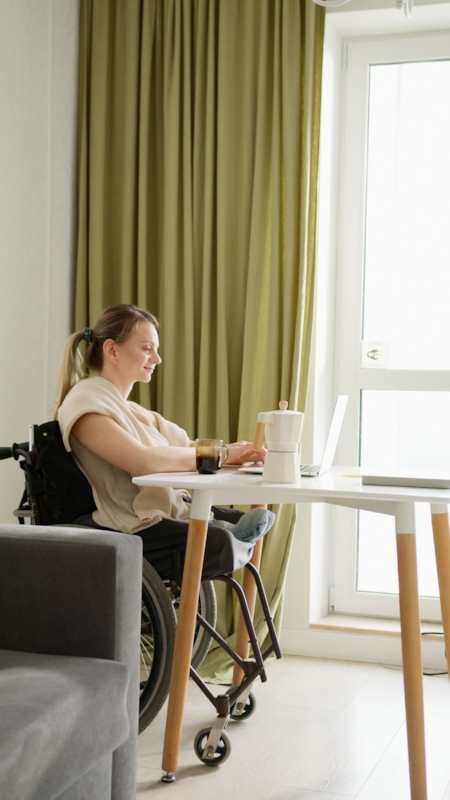
Dating as a wheelchair user comes with its own practical questions, but the core of it is the same as anyone else's: finding someone you connect with.
Plan dates around real accessibility
Checking a venue's accessibility ahead of time avoids unwelcome surprises and lets you focus on the date itself.
Your wheelchair is context, not the headline
See the full perspective on the Wheelchair Users Dating page.
Disclosure: mentioning it before meeting, not after
Mentioning wheelchair use somewhere in your profile, rather than waiting to bring it up after a connection has formed, sets honest expectations from the very first message. It also filters out, early and efficiently, anyone who wasn't going to be a good fit anyway.
Showing a photo that includes your wheelchair, if you're comfortable doing so, tends to work better than describing it only in text. It normalizes it as simply part of who you are, rather than something held back until later.
Venue accessibility as a shared planning task
Confirming a venue's actual accessibility — not just a general assumption that a place is 'probably fine' — before a first date avoids an awkward, disappointing arrival. A quick call ahead, checking for step-free entry, accessible washrooms, and table height, removes the guesswork.
This is a reasonable thing to ask a match to help coordinate, rather than carrying the entire planning burden alone. A good match will treat it as a normal part of planning a date together, not an inconvenience.
Handling unsolicited questions and comments
Strangers sometimes ask intrusive or oddly personal questions about wheelchair use, and that pattern doesn't stop just because you're dating. Deciding in advance how much you're willing to explain, and to whom, gives you a script to fall back on when an early date veers into uncomfortable territory.
It's entirely fine to redirect a conversation away from an invasive question without fully answering it. 'That's not really first-date conversation' is a complete, reasonable response.
Intimacy and physical considerations, on your own terms
Conversations about physical intimacy, when and if they become relevant, are yours to navigate at your own pace and on your own terms. There's no obligation to address it earlier than feels right, and no single 'correct' way every wheelchair user handles it.
A partner who approaches the topic with genuine curiosity and respect, rather than awkwardness or unease, is showing you something valuable about how the rest of the relationship is likely to go.
Building a community where this isn't a novelty
On a general dating platform, being a wheelchair user can sometimes feel like a novelty that needs constant explaining. Within a disability-aware community, it's simply one of many represented experiences, which tends to make the whole process less exhausting.
Disabled Dating Canada's community includes a meaningful number of wheelchair users, which means fewer conversations spent on basic education and more spent on actually getting to know someone.
Travel and accessible transportation logistics
Beyond a single date, ongoing dating often involves transportation considerations — accessible transit routes, parking, rideshare options with the right vehicle type. Factoring this into early planning conversations, rather than treating it as a minor afterthought, sets a more sustainable pattern for future dates.
A partner who takes an active interest in solving these logistics with you, rather than leaving you to manage them entirely alone, is showing real partnership early on.
Addressing assumptions directly, without exhausting yourself
Some matches will carry assumptions about what wheelchair use means for your life, your independence, or your capabilities that don't reflect reality. Correcting these patiently, when you have the energy to, helps; but you're not obligated to educate every single person who gets something wrong.
It's fine to simply move on from a match who can't get past an inaccurate assumption after a reasonable, good-faith attempt to clarify it.
Building a relationship that doesn't revolve around the wheelchair
While accessibility and logistics matter, they shouldn't become the entire substance of the relationship. Making space for the parts that have nothing to do with the wheelchair — shared humour, common interests, ordinary affection — keeps the relationship feeling like a relationship, not a series of accommodations.
A partner who can hold both — genuine attentiveness to your needs and a relationship that isn't solely defined by them — is striking exactly the right balance.
Whatever stage of dating you're in, the goal is a relationship where the wheelchair is simply a fact about your life — accommodated naturally, never apologized for, and never the only thing the relationship is about.
That's the standard worth holding out for, even if it takes some sorting through mismatches to find it.
And it's a standard worth holding for, even when the search takes longer than you'd like.
Related articles
See what's included
Compare the Classic, VIP, and VIP+ tiers and what each one unlocks.
Trust & Safety
ID verification, privacy controls, and active moderation, explained.
Ready to join?
Create your free account and start connecting with people who understand your experience.
Join Now